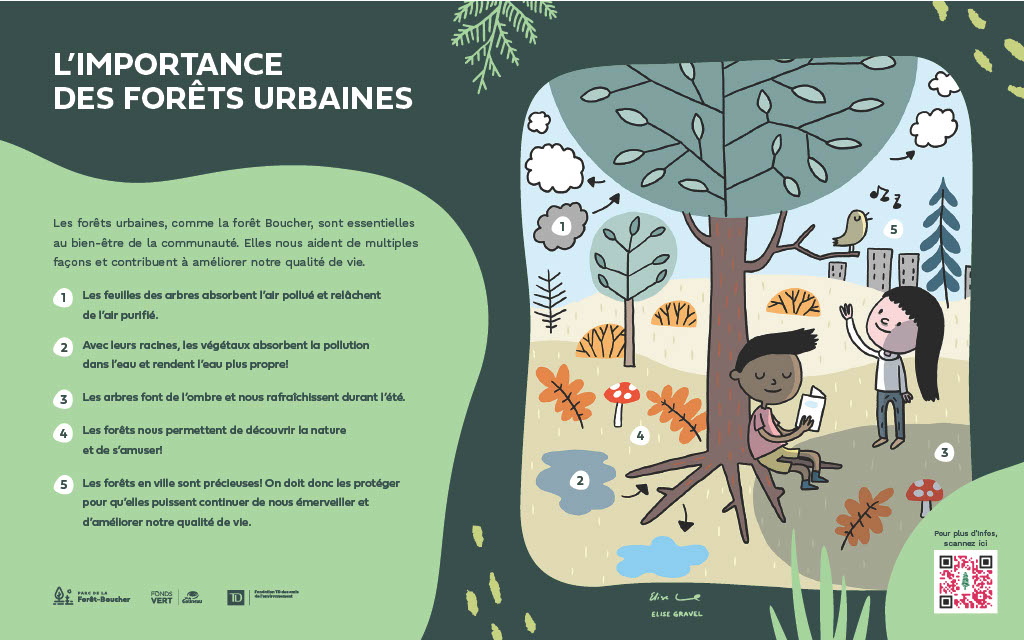
Boucher Forest contains extensive forested wetlands covering 135 hectares, representing 50% of the site’s total area.

Boucher Forest belongs to the Bitternut Hickory Sugar Maple bioclimatic domain, a region characterized by a balance between its vegetation and climate 2. It benefits from the mildest climate in Québec and is home to one of the province’s richest floras, with approximately 1,600 plant species 3. It also contains several exclusive tree species as well as the largest number of vulnerable and threatened plant species in the province 4 (Boucher Forest Park Master Plan, FFB 2019).
¹ Ducks Unlimited Canada, 2017
2 Couillard et coll. 2012 ; Gouvernement du Québec, 2016.
3 Couillard et coll. 2012
4 Couillard et coll. 2012

NOTE ON THE COMPILATION OF BOUCHER FOREST’S FAUNA AND FLORA
THREE EXCEL FILES: ANIMALIA, FUNGI AND PLANTAE
The Fondation Forêt Boucher website includes an up-to-date compilation (as of the end of December 2025) of the 1,641 fauna and flora species recorded in the forest. This inventory reflects the area’s remarkable biodiversity. It includes 545 animal species (324 insects, 5 fish, 12 amphibians, 5 reptiles, 163 birds, and 17 mammals), 547 fungi species (530 mushrooms and 17 lichens), and 549 plant species (443 vascular plants and 106 mosses). The compilation is available in three Excel files named ANIMALIA, FUNGI, and PLANTAE. These files are updated regularly as new observations are validated by experts.
The listed species come primarily from the following sources: consultant reports, bioblitzes, amateur groups (e.g. Mycologues de l’Outaouais – mao-qc.ca), and the eBird.org and iNaturalist.org websites. The data have been validated using various methods.
The list of vascular plants was reviewed by Mr. Jacques Cayouette, and the list of fungi by Ms. Yolande Dalpé. These two distinguished researchers reviewed the taxonomy and added numerous new observations based on their field surveys. We sincerely thank them for their valuable contribution.
Regarding observations from the eBird and iNaturalist websites, both organizations rely on experts to validate records. It should be noted that, in the case of iNaturalist, only observations validated by at least two experts are included. A few notes specific to each of the three files are provided below.
ANIMALIA file: Many insects do not have common names in either French or English. The common names used come from various sources, including explorer.natureserve.org and tb.termiumplus.gc.ca.
FUNGI file: The website mycoquebec.org and the latest edition of Raymond McNeil’s The Great Book of Mushrooms of Québec and Eastern Canada proved invaluable for updating the taxonomy and adding common names. The same applies to lichens, thanks to the website societequebecoisedebryologie.org.
PLANTAE file: The VASCAN database of Canadian vascular plants (data.canadensys.net) was used for plant taxonomy and common names. As with lichens, the website societequebecoisedebryologie.org was used for mosses.
Boucher Forest is a vital link in Gatineau’s Biodiversity Corridor. This unique corridor connects the shores of the Ottawa River at Deschênes to Gatineau Park. Everyone is encouraged to continue contributing to the documentation of the forest’s fauna and flora. These efforts will not only expand our knowledge of this exceptional natural area that we are fortunate to have on our doorstep, but also help document its remarkable biodiversity so it can be preserved and shared with future generations.
Jean-Serge Vincent
The Foundation Thanks Jean-Serge Vincent
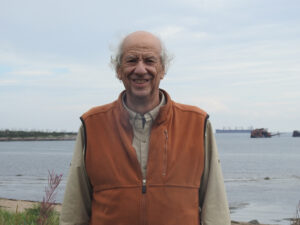
We owe a great debt of gratitude to Jean-Serge Vincent, who generously volunteered to compile the animal and plant species observed in Boucher Forest. Thanks to his outstanding work and dedication, we now have the most up-to-date and comprehensive portrait of the remarkable biodiversity found in our beloved local forest.
Jean-Serge Vincent (D.Sc.) is a Quaternary geologist. From 1968 to 2002, he worked for the Geological Survey of Canada, first as a researcher and later as a manager. He conducted research and published numerous books and scientific articles on the Quaternary geology of Québec and the Canadian Arctic. Since retiring, he has devoted his time to photographing and identifying Québec’s vascular plants and wildlife (birds, arthropods, and more). Jean-Serge also contributed to the Biodiversity and Ecosystem Inventory of the Deschênes neighbourhood. He is a resident of Aylmer.